
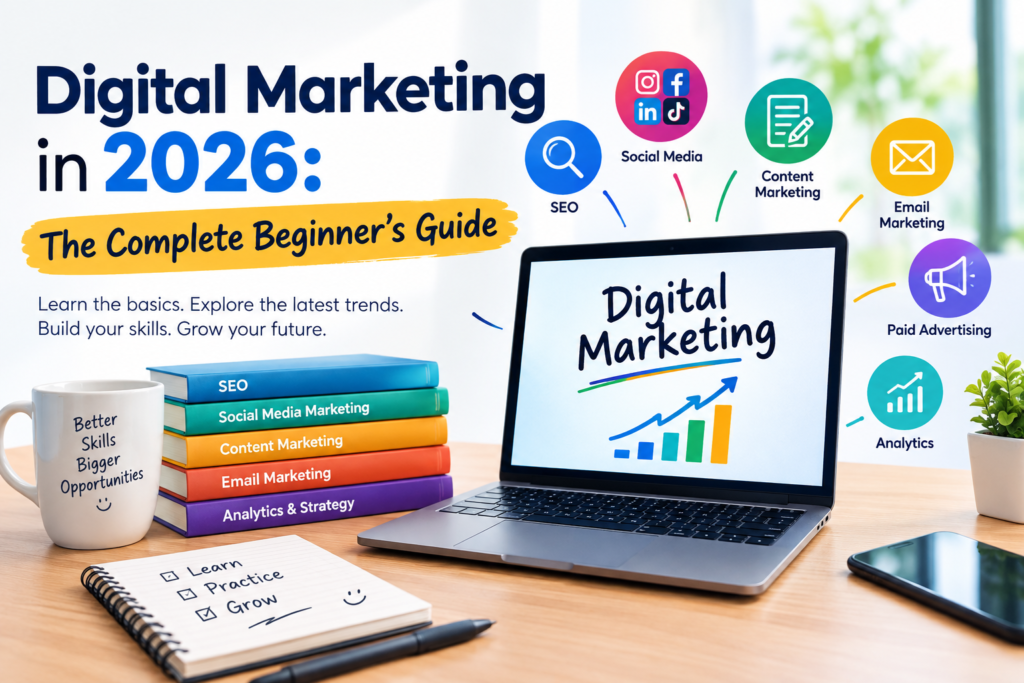
Digital Marketing in 2026: The Complete Beginner’s Guide
Digital marketing has become one of the most important ways for businesses to reach customers, build brand awareness, and increase sales. Digital Marketing in 2026: The Complete Beginner’s Guide explains the essential concepts beginners need to understand. Whether you run a small local business, work for a large company, or want to start a career in marketing, understanding digital marketing is an essential skill in 2026.
The digital landscape is changing quickly. Artificial intelligence, social media, search engines, video content, automation, and personalized customer experiences are transforming the way brands connect with their audiences.
But if you are a beginner, digital marketing can seem complicated. There are dozens of platforms, strategies, tools, and technical terms to learn.
This guide explains the fundamentals of digital marketing in simple language and shows you how to get started. Digital Marketing in 2026: The Complete Beginner’s Guide is designed to make these concepts easier to understand.
What Is Digital Marketing?
Digital marketing is the process of promoting products, services, or brands through digital channels.
Instead of relying only on traditional methods such as newspapers, television, radio, or billboards, businesses use online platforms to reach potential customers.
Common digital marketing channels include:
- Search engines such as Google
- Social media platforms
- Websites and blogs
- Online advertising
- Video platforms
- Mobile apps
- Content marketing
For example, imagine that you own a small bakery. You could use Instagram to share photos of your products, Google Search to help local customers find your bakery, email marketing to announce special offers, and online advertising to reach people in your area.
The goal is not simply to get attention. Effective digital marketing helps businesses attract the right people, build relationships with them, and eventually turn them into customers. Digital Marketing in 2026: The Complete Beginner’s Guide covers these fundamental principles for beginners.
Why Is Digital Marketing Important in 2026?
Consumers spend a significant amount of time online. They search for information, compare products, watch videos, read reviews, communicate with businesses, and make purchases using digital devices.
This makes digital marketing particularly valuable for businesses of almost every size.
One of its biggest advantages is that it allows businesses to reach highly specific audiences. Instead of showing an advertisement to everyone, marketers can target people based on factors such as interests, location, search behavior, or previous interactions with a brand.
Digital marketing can also be measured. Businesses can track website visits, clicks, leads, conversions, engagement, and other performance indicators.
In 2026, another major factor is artificial intelligence. AI is increasingly being used to analyze data, assist with content creation, automate repetitive tasks, personalize experiences, and improve marketing workflows.
However, technology does not replace good marketing fundamentals. Understanding your customers, creating useful content, and building trust remain essential. Digital Marketing in 2026: The Complete Beginner’s Guide highlights the importance of combining technology with these fundamentals.
The Major Types of Digital Marketing
Digital marketing includes several different areas. You do not need to master everything immediately. Start with the fundamentals and gradually develop your skills.
1. Search Engine Optimization (SEO)
SEO is the process of improving a website so that it can appear more prominently in search engine results.
For example, if someone searches for “best digital marketing agency,” businesses offering digital marketing services want their websites to appear when potential customers perform that search.
SEO involves several areas, including:
- Keyword research
- High-quality content
- On-page optimization
- Website structure
- Technical performance
- Internal linking
- Backlinks
- User experience
SEO is often considered a long-term marketing strategy because building visibility and authority can take time.
The most important principle for beginners is simple: create useful content that genuinely answers what your audience is searching for.
2. Content Marketing
Content marketing involves creating and distributing useful information to attract and engage a target audience.
Content can include:
- Blog posts
- Videos
- Social media posts
- Podcasts
- Infographics
- Guides
- Case studies
- Ebooks
For example, a fitness company could publish articles about healthy eating, workout routines, and fitness tips instead of constantly promoting its products.
Useful content can help a business establish authority and build trust before asking customers to make a purchase. Digital Marketing in 2026: The Complete Beginner’s Guide shows how content can support these marketing goals.
3. Social Media Marketing
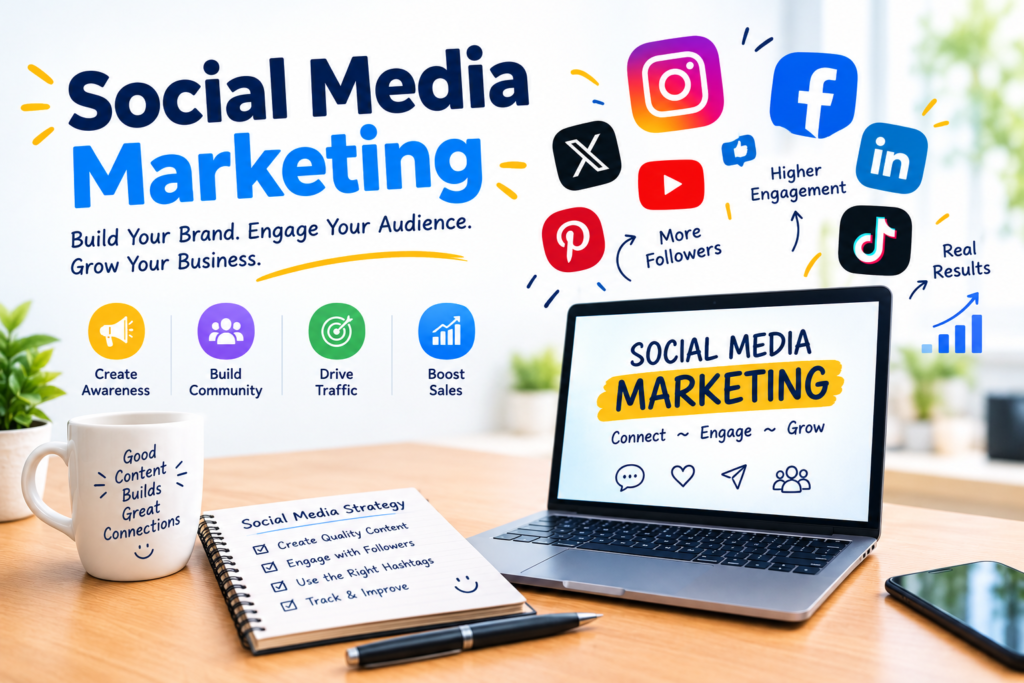
Social media marketing involves using social platforms to build awareness, communicate with audiences, and promote products or services.
Different platforms attract different audiences and content styles. Some businesses may benefit from short-form video, while others may find professional networking platforms or visual content more effective.
Successful social media marketing is about more than simply posting content every day.
It involves:
- Understanding your target audience.
- Choosing appropriate platforms.
- Creating valuable and engaging content.
- Responding to comments and messages.
- Monitoring performance.
- Improving your strategy based on results.
In 2026, short-form video, creator collaborations, community building, and authentic content continue to be important areas for marketers to understand.
4. Email Marketing
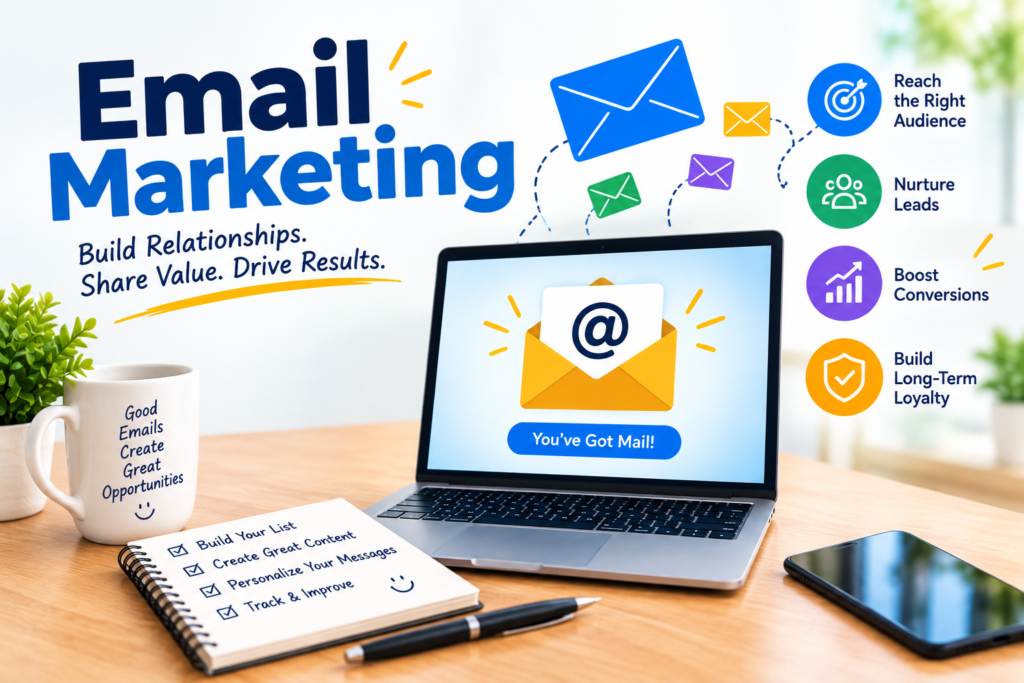
Email marketing allows businesses to communicate directly with people who have voluntarily joined their email lists.
Businesses can use email to:
- Welcome new subscribers
- Share educational content
- Promote products
- Announce offers
- Send newsletters
- Recover abandoned purchases
- Build customer relationships
A good email campaign focuses on relevance rather than sending as many emails as possible.
Personalization and automation can also make email marketing more effective. For example, someone who downloads a beginner’s guide could automatically receive a series of helpful follow-up emails. Digital Marketing in 2026: The Complete Beginner’s Guide includes email marketing as an important channel for beginners to understand.
5. Pay-Per-Click Advertising
Pay-per-click, commonly called PPC, is a form of online advertising where advertisers generally pay when someone clicks on an advertisement.
Search advertising can place businesses in front of people who are actively looking for particular products or services. Social advertising can help businesses reach audiences based on selected characteristics and interests.
PPC can generate results faster than many organic strategies, but it requires careful budgeting and optimization. Digital Marketing in 2026: The Complete Beginner’s Guide explains why understanding paid advertising is important for beginners.
Beginners should learn about:
- Target audiences
- Keywords
- Ad copy
- Landing pages
- Conversion tracking
- Cost per click
- Return on ad spend
6. Affiliate Marketing
Affiliate marketing is a performance-based approach where individuals or organizations promote another company’s products or services and receive a commission for qualifying sales or actions.
For example, a blogger might recommend a software product and earn a commission when readers purchase it through a tracked referral.
Affiliate marketing can benefit both businesses and creators when recommendations are relevant, transparent, and genuinely useful. Digital Marketing in 2026: The Complete Beginner’s Guide provides a foundation for understanding how different digital channels work together.
How Artificial Intelligence Is Changing Digital Marketing
AI is one of the biggest developments in digital marketing in 2026. Digital Marketing in 2026: The Complete Beginner’s Guide explains how AI is becoming an important part of modern marketing.
Marketers can use AI tools to assist with tasks such as:
- Brainstorming content ideas
- Analyzing customer data
- Creating initial content drafts
- Generating variations of advertisements
- Summarizing research
- Automating repetitive workflows
- Personalizing customer communication
However, AI-generated content should not simply be published without review.
Human expertise is still important for accuracy, originality, brand voice, creativity, and understanding customer needs.
The strongest approach is often to use AI as an assistant rather than treating it as a complete replacement for human judgment.
How to Create a Digital Marketing Strategy
A successful digital marketing campaign starts with a strategy. Digital Marketing in 2026: The Complete Beginner’s Guide helps beginners understand the basic steps involved in creating an effective strategy.
Step 1: Define Your Target Audience
Before creating content or advertisements, understand who you want to reach.
Consider questions such as:
- Who are your ideal customers?
- What problems do they have?
- What are they interested in?
- Where do they spend time online?
- What motivates them to buy?
Step 2: Set Clear Goals
Your goals should be specific and measurable.
Examples include:
- Increase website traffic
- Generate more leads
- Increase online sales
- Grow an email list
- Improve brand awareness
- Increase social media engagement
Step 3: Choose Your Channels
You do not need to be everywhere.
Choose marketing channels based on where your audience is most active and what your business wants to achieve.
A local service business may prioritize local SEO and search advertising, while a fashion brand might focus heavily on visual social content.
Step 4: Create Valuable Content
Create content that helps your audience solve problems or make decisions.
Instead of asking, “What can we sell today?” ask, “What does our audience need help with?”
This change in perspective can significantly improve the quality of your marketing. Digital Marketing in 2026: The Complete Beginner’s Guide emphasizes the importance of creating useful content for your audience.
Step 5: Measure Your Results
Use analytics to understand what is working.
Important metrics may include:
- Website traffic
- Engagement rate
- Leads
- Conversion rate
- Customer acquisition cost
- Return on investment
- Email open and click rates
Do not focus on vanity metrics alone. Having thousands of followers is not necessarily valuable if they never engage with your business or become customers.
Essential Digital Marketing Skills for Beginners
If you want to build a career in digital marketing, focus on developing a combination of technical and creative skills. Digital Marketing in 2026: The Complete Beginner’s Guide can help beginners understand the key areas they should develop.
Important skills include:
SEO: Learn how search engines work and how websites can improve their organic visibility.
Content writing: Learn how to communicate clearly and create useful content.
Social media: Understand different platforms, audiences, formats, and engagement strategies.
Analytics: Learn how to interpret data and use it to make better decisions.
Advertising: Understand the basics of paid search and social advertising.
AI literacy: Learn how to use AI tools responsibly and effectively.
Communication: Marketing involves communicating ideas to customers, clients, designers, developers, and other team members.
You do not need to become an expert in all these areas at once. Choose one area, learn the fundamentals, practice regularly, and expand from there.
Common Digital Marketing Mistakes Beginners Should Avoid
Many beginners make the mistake of trying too many strategies at the same time. Digital Marketing in 2026: The Complete Beginner’s Guide also highlights the importance of avoiding common mistakes when starting your digital marketing journey.
Here are some common mistakes to avoid:
Ignoring the target audience: Marketing becomes much harder when you do not understand who you are trying to reach.
Expecting immediate SEO results: Organic search visibility often requires consistent effort and patience.
Creating content without a purpose: Every piece of content should support a clear audience need or business objective.
Chasing followers instead of customers: A smaller, relevant audience can be more valuable than a large but uninterested one.
Ignoring analytics: Without measuring results, you cannot reliably determine what works.
Relying completely on AI: AI can improve productivity, but human review and original thinking remain essential.
Using every platform: More channels do not automatically mean better marketing. Focus on the platforms that matter to your audience.
Digital Marketing in 2026: The Complete Beginner’s Guide emphasizes the importance of avoiding these common mistakes while building a strong marketing foundation.
The Future of Digital Marketing
Digital marketing will continue to evolve as technology and consumer behavior change.
AI will likely become increasingly integrated into marketing workflows. Search experiences will continue to evolve, video will remain important, and customers will expect increasingly relevant and personalized experiences.
At the same time, trust will become even more valuable.
Consumers have access to enormous amounts of information, advertising, and AI-generated content. Businesses that provide genuine value, demonstrate expertise, communicate transparently, and understand their customers can build stronger long-term relationships.
This means the future of digital marketing is not only about using the newest technology. It is about combining technology with creativity, strategy, data, and human understanding.
Final Thoughts
Digital marketing can seem overwhelming when you are first starting, but you do not need to learn everything at once.
Start with the fundamentals: understand your audience, create useful content, learn how search and social media work, explore email and advertising, and measure your results.
As you gain experience, you can specialize in areas such as SEO, content marketing, social media, paid advertising, email marketing, analytics, or AI-powered marketing.
The most important thing is to keep learning and experimenting. Digital marketing changes constantly, and successful marketers are those who adapt while staying focused on what matters most: helping the right audience find, trust, and choose a business.
Digital Marketing in 2026: The Complete Beginner’s Guide provides a starting point for students, aspiring marketers, entrepreneurs, and business owners who want to understand the modern digital marketing landscape.
Whether you are a student, aspiring marketer, entrepreneur, or business owner, learning digital marketing in 2026 can give you valuable skills for navigating the modern digital economy.